
PRACTICAL LEGAL TRAINING WESTERN AUSTRALIA
If you're studying law in Western Australia, Practical Legal Training (PLT) helps you turn what you've learned at university into the practical skills used in legal practice.
The College of Law has been training WA lawyers since 2006. Our PLT program is accredited by the Legal Practice Board of Western Australia (LPBWA) and focuses on helping you develop the practical skills you’ll use in legal practice, with no essays or written exams.
Choose full-time, balanced, or part-time study, with flexible options that fit around work and other commitments. Workshops are available online or in person at our Perth campus.
WHAT IS PRACTICAL LEGAL TRAINING IN WESTERN AUSTRALIA?
Practical Legal Training (PLT) is the next step between completing your law degree and being admitted as a legal practitioner in Western Australia. After completing PLT with the College of Law, you will be awarded a Graduate Diploma of Legal Practice (GDLP). This is the qualification that makes you eligible to apply for admission to the legal profession in Western Australia through the Legal Practice Board of Western Australia (LPBWA), with admission granted by the Supreme Court of Western Australia.

Key facts for Western Australian graduates:
- Complete your PLT in 15–30 weeks
- Choose between 25 or 75 days of work experience
- Study mostly online with workshops online or at our Perth campus
- Flexible study options: full-time, part-time, or balanced
- Learn through practical tasks that reflect day-to-day legal work
- Graduate with a Graduate Diploma of Legal Practice (GDLP) recognised by the LPBWA
HOW YOUR PLT WORKS
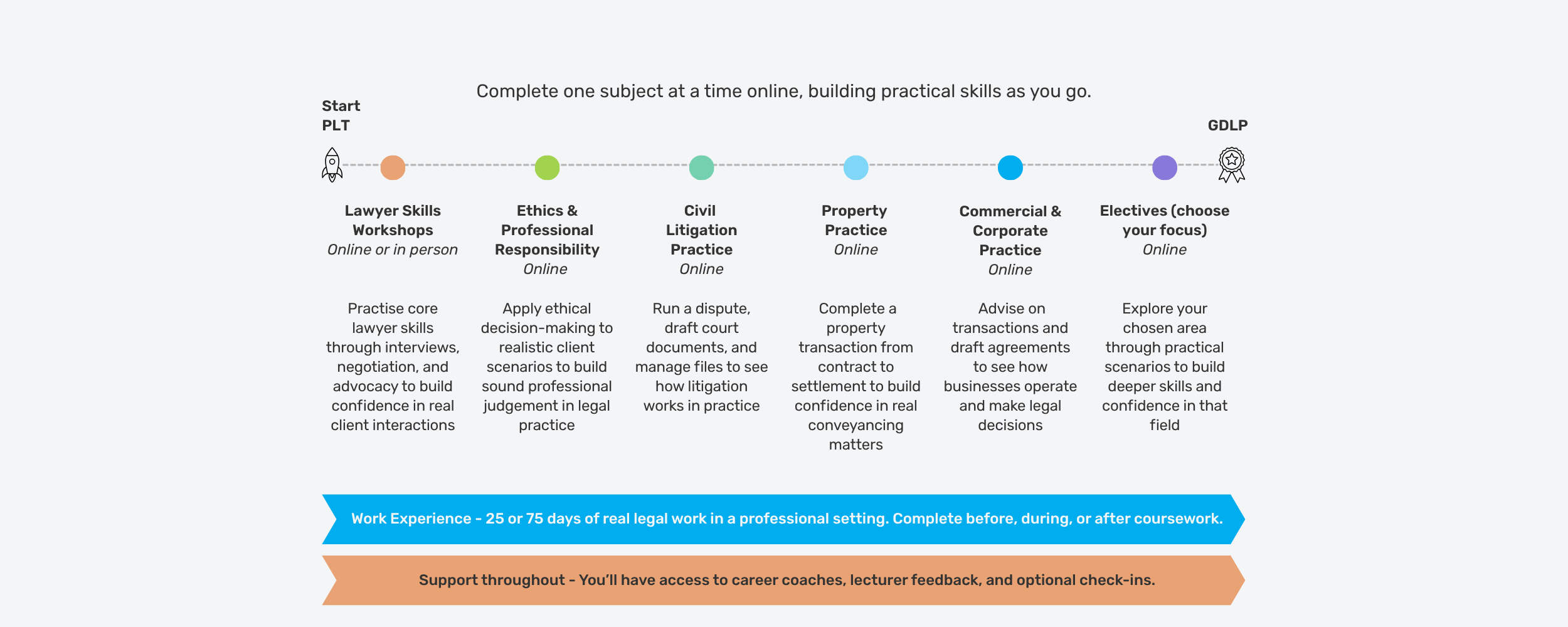
Your PLT is built around coursework and work experience, and you have up to four years to complete the program.
COURSEWORK
This is where you move past theory and start doing the work lawyers actually do.
Your PLT coursework in Western Australia is designed to build practical legal skills through a combination of online learning and interactive workshops.
Most of your study takes place online through the Learning Portal, where you’ll complete practical legal tasks such as drafting documents, advising clients, and managing files. Your facilitator will provide feedback as you work through each subject.
Workshops are built into your coursework and focus on developing practical skills through real-time interaction, including advocacy, negotiation, and client interviews. These sessions are highly interactive and run as role-plays and guided exercises.
Depending on your course:
- You’ll attend 5 days of workshops, or
- 10 days of workshops, or
- 12 evening workshops
Workshops can be completed online or in person at our Perth campus, depending on your course and your preference.
No written exams. No essays. Just hands-on legal practice.
Instead, you’ll develop your skills through practical, real-world tasks:
- Practical tasks: Work through simulated legal files (typically 2–3 tasks per week full-time, or 1–2 tasks per week part-time), with detailed feedback from your facilitator
- Huddles: Optional small-group sessions to ask questions and discuss your work
- Progress quizzes: Short knowledge checks at the end of each subject, designed to support your learning
- Practice ready reviews: A 45-minute open-book conversation with a supervising lawyer at the end of each subject, similar to reporting to a senior lawyer in practice
- Lawyer Skills
- Ethics and Professional Responsibility
- Civil Litigation Practice
- Property Law Practice
- Commercial and Corporate Practice
- Administrative Law
- Criminal Law
- Family Law
- Consumer Law
- Employment Law
- Planning and Environmental Law
- Wills and Estates
- Banking and Finance
WORK EXPERIENCE
Options
Option 1:
75 days' work experience
Complete 75 days in a legal workplace.
Option 2:
25 days + 5-week online program
Complete 25 days of work experience plus an additional five weeks of online coursework.
Work experience is where you apply what you’re learning in a real legal workplace.
As part of Practical Legal Training in Western Australia, you'll complete either 15 or 75 days of work experience. This gives you the opportunity to build practical skills and see how legal work happens day-to-day.
You’ll organise your own placement and can complete your days in one workplace or across multiple organisations.
You don’t need a placement organised before you enrol. Many students complete their work experience during the course.
As a College PLT student, you’ll have access to Career Coaches who can help you get started and prepare applications.
HOW LONG DOES PLT TAKE IN WESTERN AUSTRALIA?
In Western Australia, the coursework component of Practical Legal Training (PLT) generally takes between 15 and 30 weeks, depending on the study option you choose.
You’ll also complete work experience in a legal workplace. In Western Australia, this can be either 25 days or 75 days, depending on the pathway you select.
The total time it takes to complete PLT will depend on when you complete your work experience. Some students complete their placement during their coursework, while others may complete part or all of it before or after their course.
Once you’ve completed both your coursework and work experience, you’ll be awarded a Graduate Diploma of Legal Practice (GDLP), which allows you to apply for admission through the Legal Practice Board of Western Australia.

Western Australia PLT Entry Requirements
Many students begin PLT shortly after finishing their law degree, although some choose to start earlier with LPAB approval.
To enrol in PLT in Western Australia, you must:
- Have completed your Priestley 11 core subjects
- You’ve finished the last exam of your law degree (or your double degree)
- You can provide your final results one week before your course begins
Stale learning clause
If you completed your law degree more than five years ago, you will need to have your qualifications assessed by the Legal Practice Board of Western Australia before commencing PLT.

Starting PLT early in Western Australia
In some cases, you may be able to start PLT before completing your law degree.
To do this, you’ll need approval from the Legal Practice Board of Western Australia (LPBWA). You may be eligible if you:
- Have completed all Priestley 11 core subjects
- Have no more than two electives remaining in your law degree or double degree
- Are currently enrolled in the remaining subject(s) while undertaking PLT
To apply, you must provide the LPBWA with:
- A signed statutory declaration (original must be posted to the LPBWA), including:
- Your university name and enrolled degree
- Confirmation of completion of all Priestley 11 core subjects
- Confirmation of enrolment in your remaining subjects and their expected completion dates
- The name, course code, start date, and end date of your intended College of Law PLT program
- An academic transcript - arranged directly by your law school (emailed or posted to the LPBWA). A transcript sent directly from your university is preferred over a student-provided original.
PLT COURSE OPTIONS IN WESTERN AUSTRALIA
FEES & PAYMENT
Program Fees
Practical Legal Training
Domestic $9,200
International $13,270
Optional 25 days' work experience & 5-week coursework
Domestic $1,620
International $1,620
What’s included
Your PLT fee covers everything you need to complete the course. This includes:
- All learning materials and resources
- One-on-one career consultations with our Career Coaches during your PLT and for one year after you finish
- Access to a legal practitioner mentor
- Access to College Connect, our online student community
- Ongoing support from facilitators and student services
Payment options
- FEE-HELP (eligible students)
- Upfront payment
- Scholarships and bursaries
MEET YOUR PRACTICAL LEGAL TRAINING LECTURERS IN WESTERN AUSTRALIA
Your PLT is taught by experienced Western Australian legal practitioners who understand how law is practised in the state. They guide you through practical skills and legal scenarios based on the Western Australian legal system, rules, and professional practice, helping you prepare for legal work in Western Australia.

Kathy Bogoyev
Assistant Director
BA, LLB (Hons), GradCertMed (Fam), GAICD
Kathy is a senior legal practitioner with broad and diverse experience as General Counsel and Company Secretary, a Senior Solicitor in the government legal service and Principal Solicitor at a community legal centre.

Max Lewington
Lecturer
BA Jurisprudence, MA
Before working at the College, Max was Practice Director, Legal Services, Department of Communities (formerly Child Protection). Prior to that, Max was Solicitor-in-Charge Dispute Resolution Program, Legal Aid WA and was in Private Practice as partner, sole practitioner and employed solicitor working across Criminal Law, Family Law, Conveyancing and Property, Commercial Litigation and Wills and Estates.

Greg Wolff
Lecturer
BA, LLB
Greg Wolff, admitted in SA and WA, now practices solely in Wills and Estate Planning.
FREQUENTLY ASKED QUESTIONS
Yes. The College of Law is an approved PLT provider accredited by the Legal Practice Board of Western Australia (LPBWA) under the Legal Profession Uniform Law (WA) and the Legal Profession Uniform Admission Rules 2015. Completing the program makes you eligible to apply for admission before the Supreme Court of Western Australia.
You can enrol before your results are available, but you must have them submitted to the College by the enrolment close date — one week before the course begins. If you are applying for early commencement, you will need to provide approval by the LPBWA by the Wednesday before your start date.
The 25-day option is a WA-exclusive pathway that combines 25 days of supervised legal work experience with a 5-week online program. At least 15 of those days must be completed after starting your PLT, at a minimum of 2 days per week. The remaining 10 days can be completed before, during, or after your PLT (within the prior 2 years). The additional fee is $1,620 (FEE-HELP available).
Yes. Work experience undertaken before starting PLT can count toward the flexible portion of your requirement (up to 10 days for the 25-day option or up to 60 days for the 75-day option), provided it was completed within two years of your PLT start date and complies with the Work Experience Rules. At least 15 days must always be completed after starting PLT.
Yes. College of Law evening workshops in WA are scheduled after 5:30 pm, making the part-time course accessible for graduates who work during the day.
No. There are no written exams or essays. Assessment is via practical tasks and a "practice ready review" — an open-book conversation with a supervising lawyer at the end of each subject, modelled on a real supervising lawyer and junior discussion.
Apply to the LPBWA. You will need to post an original signed statutory declaration to the Board and arrange for your university to send your academic transcript directly to the LPBWA. The College of Law needs evidence of LPBWA approval by the Wednesday before your course starts. Note that unlike some other states, this process involves posting an original statutory declaration — allow sufficient lead time.
Yes. FEE-HELP is available for eligible domestic students for the main course fee ($9,200) and for the 25-day work experience additional coursework fee ($1,620).
Yes. Your Graduate Diploma of Legal Practice (GDLP) is recognised across Australia. You can seek admission in other states and territories through the mutual recognition framework, noting that South Australia and Tasmania have specific additional requirements.
No — you can complete PLT in any state. However, WA coursework is tailored to WA jurisdiction-specific requirements and procedures, which provides the most relevant preparation if you plan to practise in WA.
ABOUT THE COLLEGE OF LAW WESTERN AUSTRALIA
The College of Law has been educating the legal profession for more than 50 years. Established in 1974, the College has helped over 100,000 graduates start their legal careers across Australia.
In Western Australia, the College has delivered Practical Legal Training since XXXX, supporting law graduates as they transition from university into legal practice. The program is approved by the Legal Practice Board of Western Australia (LPBWA), the authority responsible for accrediting PLT providers in the state.
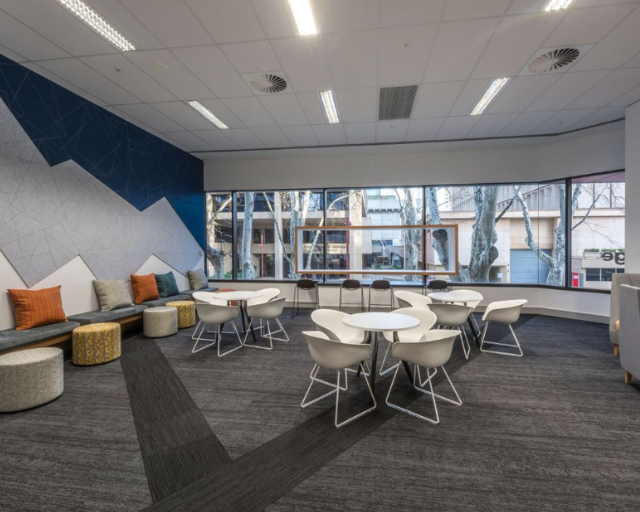
Our Perth campus at Durack Centre, 263 Adelaide Terrace, places students in the centre of the city’s legal precinct, close to courts, law firms, and the profession they are preparing to join.
As a not-for-profit provider, the College works closely with practising lawyers, employers, and the wider profession to ensure its Practical Legal Training reflects the skills needed in modern legal practice.
The College delivers PLT programs across Australia, with campuses in Sydney, Melbourne, Adelaide, and Perth, and courses accredited by the relevant legal admissions authorities in each state.