
PRACTICAL LEGAL TRAINING QUEENSLAND
If you're completing your law degree in Queensland and planning to become a solicitor, Practical Legal Training (PLT) helps you develop the practical skills used in legal practice. The program focuses on practical learning designed to prepare you for legal practice in QLD, with no written exams or academic essays.
Choose full-time, balanced, or part-time study, with workshops delivered on campus in Brisbane and online options available in certain circumstances.
When you complete the program, you'll be awarded a Graduate Diploma of Legal Practice (GDLP), the qualification used to apply for admission to the legal profession in Queensland.
WHAT IS PRACTICAL LEGAL TRAINING IN QUEENSLAND?
Practical Legal Training (PLT) is the next step between your Queensland law degree and admission as a solicitor. When you complete your PLT, you are awarded a Graduate Diploma of Legal Practice (GDLP), the qualification required to apply for admission to the legal profession in Queensland.
The College of Law's Queensland PLT program is approved by the Legal Practitioners Admissions Board Queensland (LPAB), the body that accredits PLT providers in Queensland.

Key facts for Queensland graduates:
- Complete your PLT in 15–30 weeks
- Choose between 15 or 75 days of work experience
- Workshops are held on campus in Brisbane, with limited online options
- Study mostly online with structured workshop components
- Build skills through practical legal tasks and real-world scenarios
- Graduate with a Graduate Diploma of Legal Practice (GDLP) approved by the LPAB
HOW PLT QUEENSLAND WORKS
Your PLT at the College of Law includes coursework and work experience, and you have up to four years to complete the program.
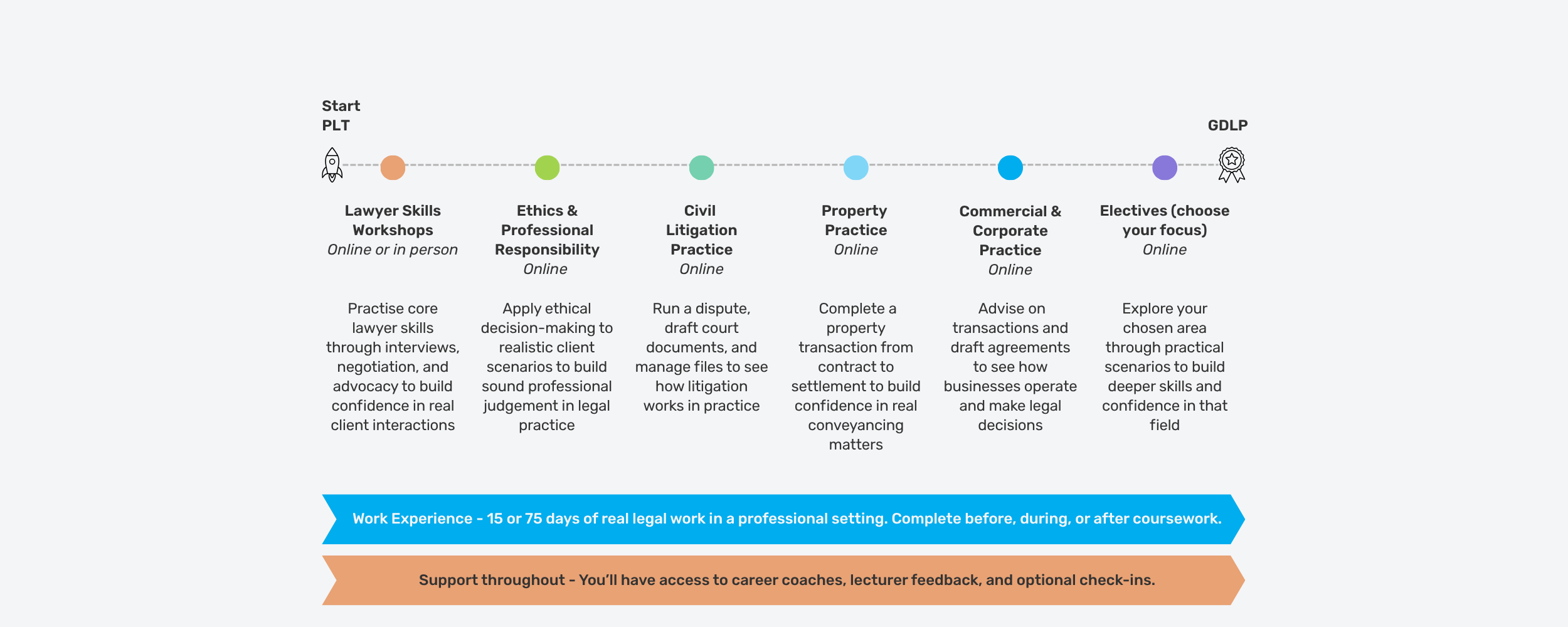
COURSEWORK
Skip the lectures and theory. This is where you learn by doing.
Your PLT coursework in Queensland is designed to help you build practical legal skills through a mix of online learning and structured workshops.
Most of your learning happens online in the Learning Portal, where you’ll complete practical tasks that reflect real legal work, such as drafting documents, advising clients, and managing legal matters. Your facilitator will review your work and provide feedback throughout the course.
Workshops are built into your coursework and focus on skills that benefit from real-time interaction, including advocacy, negotiation, and client interviews. These sessions are highly interactive and run as role-plays and guided exercises.
Depending on your course:
- You’ll attend 5 days of workshops, or
- 10 days of workshops, or
- 12 evening workshops
Workshops are typically held on campus in Brisbane, with online attendance available in certain circumstances.
No written exams. No academic grading. Just practical legal work.
There are no written exams or academic essays in PLT.
Instead, your progress is guided through practical, skills-based activities:
- Practical tasks: Work through simulated legal files (typically 2–3 tasks per week full-time), with feedback from your facilitator
- Huddles: Optional group check-ins where you can ask questions and talk through your work
- Progress quizzes: Short knowledge checks at the end of each subject that you can retake to support your learning
- Practice ready reviews: A 45-minute open-book conversation with a supervising lawyer at the end of each subject, reflecting how legal work is reviewed in practice
- Lawyer Skills
- Ethics and Professional Responsibility
- Civil Litigation Practice
- Property Law Practice
- Commercial and Corporate Practice
- Administrative Law Practice
- Criminal Law Practice
- Family Law Practice
- Consumer Law Practice
- Employment and Industrial Law Practice
- Planning and Environmental Law Practice
- Wills and Estates Practice
- Banking and Finance Practice
WORK EXPERIENCE
Options
Option 1:
75 days' work experience
Complete 75 days in a legal workplace.
Option 2:
15 days + 6-week online program
Complete 15 days of work experience plus an additional six weeks of online coursework.
Work experience is where you apply what you’re learning in a real legal workplace.
As part of Practical Legal Training in Queensland, you'll complete either 15 or 75 days of work experience. This gives you the opportunity to build practical skills and see how legal work happens day-to-day.
You’ll organise your own placement and can complete your days in one workplace or across multiple organisations.
You don’t need a placement organised before you enrol. Many students complete their work experience during the course.
As a College PLT student, you’ll have access to Career Coaches who can help you get started and prepare applications.
HOW LONG DOES PLT TAKE?
In Queensland, the coursework component of Practical Legal Training (PLT) usually takes between 15 and 30 weeks, depending on your study mode.
You’ll also need to complete work experience in a legal workplace. In Queensland, this is typically 15 or 75 days, depending on the option you choose.
The overall time to complete PLT will depend on how you structure your work experience. Many students complete their placement during their coursework, while others may complete it before or after their course.
After finishing both your coursework and work experience, you’ll be awarded a Graduate Diploma of Legal Practice (GDLP), which allows you to apply for admission through the Queensland admitting authority.

Queensland PLT Entry Requirements
Many students begin PLT shortly after finishing their law degree, although some choose to start earlier with LPAB approval.
To enrol in PLT in Queensland, you must:
- Have completed all Priestley 11 core subjects of your law degree
- You’ve finished last exam of your law degree (or double degree)
Note: You are not required to provide proof of completion of your law degree to enrol. You have until the end of the program to submit your results.
Stale learning clause
If you completed your law degree more than 5 years ago, you will need to have your qualifications assessed by the Legal Practitioners Admissions Board Queensland before enrolling.

Starting PLT early in Queensland
In some cases, you may be able to start PLT before completing your law degree.
To do this, you’ll need approval from the Legal Practitioners Admissions Board Queensland (LPAB). You may be eligible if you:
- Have completed all Priestley 11 core subjects
- Have no more than two elective subjects remaining in your law degree
- Are currently enrolled in those remaining subjects
How to apply for early commencement:
- Complete the online enrolment form for PLT at College of Law
- The College will email a conditional offer to you and the LPAB
- Contact the LPAB directly to finalise the process
- Allow a minimum of 2 weeks for the LPAB to process your application — submit your enrolment form at least 3 weeks before your course start date
- Provide proof of LPAB approval by the Wednesday before your PLT start date
PLT COURSE OPTIONS IN QUEENSLAND
PART-TIME
30 weeks
30-35 hrs study per week
5 days or 12 evenings
Brisbane CBD
FEES & PAYMENT
Program Fees
Practical Legal Training
Domestic $9,200
International $13,270
Optional 15 days' work experience & 6-week coursework
Domestic $1,690
International $1,690
What’s included
Your PLT fee covers everything you need to complete the course. This includes:
- All learning materials and resources
- One-on-one career consultations with our Career Coaches during your PLT and for one year after you finish
- Access to a legal practitioner mentor
- Access to College Connect, our online student community
- Ongoing support from facilitators and student services
Payment options
- FEE-HELP (eligible students)
- Upfront payment
- Scholarships and bursaries
MEET YOUR PRACTICAL LEGAL TRAINING LECTURERS IN QUEENSLAND
Your PLT is taught by experienced Queensland legal practitioners who understand how law is practised in the state. They guide you through practical skills and legal scenarios based on the Queensland legal system, rules, and professional practice, helping you prepare for legal work in Queensland.

Tara Cush
Lecturer
BSc, LLB(Hons), GDLP
Tara has lectured at the College since 2012 and was a solicitor in private practice for 11 years.

Leisa Flatley
Adjunct Lecturer
LLB, GDLP, Dip of Law
Leisa Flatley, College lecturer since 2014, is a former insurance litigator and claims manager.

Graeme Haas
Senior Lecturer
LLB
Graeme is a a Senior Lecturer at the College of Law and also a Mental Health First Aid Instructor.

Anita Hall
Senior Lecturer
BA, LLB(Hons), GCHEd, MEd, MQLS
From a professional background in commercial litigation, Anita now helps new lawyers develop skills for legal practice in the PLT program. Anita also volunteers at Caxton Legal Centre, advising on civil and human rights issues.

Jennifer Sturgess
Lecturer
BA, BEcon, LLB(Hons), GDLP, LLM
Jennifer was admitted as a solicitor in 1996. She has over 11 years’ experience as a practitioner in private practice working for general and professional indemnity insurers.
FREQUENTLY ASKED QUESTIONS
Yes. The College of Law's Practical Legal Training program is approved by the Legal Practitioners Admissions Board Queensland (LPAB). Successful completion leads to the award of a Graduate Diploma of Legal Practice (GDLP), which satisfies the practical legal training requirement for admission to the legal profession in Queensland.
Admission to the legal profession in Queensland is granted by the Supreme Court of Queensland, upon recommendation from the LPAB. Once you have completed your law degree, your PLT (GDLP), and are assessed as a "fit and proper person," you can apply to the LPAB for a certificate of compliance and then apply to the Supreme Court for admission.
Yes. If you have completed all Priestley 11 core subjects and have no more than two elective subjects remaining, you can apply to start PLT early. Submit your enrolment form at least three weeks before your course start date, as the LPAB requires a minimum of two weeks to process the application.
No. In Queensland, you are not required to provide proof of completion of your law degree at enrolment. You have until the end of your PLT program to provide your exam results — one of the most flexible arrangements in Australia.
Yes. Queensland students can attend workshops after 5:30 pm. The part-time course includes either 5 daytime or 12 evening workshop sessions, giving you genuine flexibility if you are working or have daytime commitments.
No. College of Law's PLT has no traditional written exams or essays. Assessment is through practice tasks, progress quizzes (retakeable), and a practice ready review — a structured conversation with a supervising lawyer that mirrors a real junior–supervisor interaction.
Yes. FEE-HELP is available for eligible domestic students on the PLT coursework component ($9,200). FEE-HELP is also available for the 15-day work experience add-on ($1,690). The 75-day work experience option is included in the base PLT fee with no additional cost.
Work experience must occur in the delivery of legal services and be supervised by an eligible Australian legal practitioner. Eligible experience includes summer clerkships, paralegal work, community legal centre volunteering, Legal Aid, government legal work, and more. You can accrue up to 60 days of experience in the two years before starting your PLT.
Yes. Remote work experience is permitted, provided you complete the Work Experience Remote Supervision Diary and comply with all Work Experience Rules.
If more than five years have passed since you completed your law degree, the LPAB requires you to have your qualifications assessed before enrolling in PLT. Contact the Legal Practitioners Admissions Board Queensland directly for guidance.
Yes. You can transfer between PLT programs. Transfers or deferrals after the census date will incur a fee. If you are unsure, the part-time course offers a more manageable pace at 15–17 hours per week over 30 weeks.
If your law degree is from overseas, you will first need your qualifications assessed by the LPAB. Based on their assessment, you may need to complete specific PLT subjects or additional academic subjects at an Australian law school. The College of Law offers a flexible part program for students who only need to complete specific PLT subjects (available in QLD).

ABOUT THE COLLEGE OF LAW QUEENSLAND
The College of Law has been educating the legal profession for more than 50 years. Established in 1974, the College has helped over 100,000 graduates start their legal careers across Australia.
In Queensland, the College has delivered Practical Legal Training since 2005, supporting law graduates as they transition from university into legal practice. The program is approved by the Legal Practitioners Admissions Board Queensland (LPAB), the authority responsible for accrediting PLT providers in the state.
Our Brisbane campus at Level 5, Wesley House, 140 Ann Street places students in the centre of the city’s legal precinct, close to courts, law firms, and the profession they are preparing to join.
As a not-for-profit provider, the College works closely with practising lawyers, employers, and the wider profession to ensure its Practical Legal Training reflects the skills needed in modern legal practice.
The College delivers PLT programs across Australia, with campuses in Sydney, Melbourne, Adelaide, and Perth, and courses accredited by the relevant legal admissions authorities in each state.