
PRACTICAL LEGAL TRAINING IN THE ACT
If you’re planning to practise law in the Australian Capital Territory (ACT), Practical Legal Training is your next step after your law degree.
The College of Law offers a PLT ACT program approved by the Legal Practitioners Admission Board ACT (LPAB ACT). When you finish, you’ll graduate with a Graduate Diploma of Legal Practice (GDLP), the qualification required to apply for admission to the ACT Supreme Court.
You can study full-time or part-time, with most of your coursework completed online and workshops delivered online or on campus. Everything is designed to help you build practical skills and feel confident stepping into legal practice.
WHAT IS PRACTICAL LEGAL TRAINING (PLT) IN THE ACT?
Practical Legal Training (PLT) is the stage between completing your law degree and applying for admission as a lawyer in the ACT. It focuses on developing the practical skills you’ll use in day-to-day legal work, from drafting and advising to managing files and working with clients.
When you complete PLT, you’ll be awarded a Graduate Diploma of Legal Practice (GDLP), which allows you to apply for admission through the ACT Supreme Court.
In the ACT, PLT providers are approved by the Legal Practitioners Admission Board ACT (LPAB ACT). The College of Law offers flexible study options, with regular start dates and the ability to complete most of your coursework online, so you can fit PLT around work and other commitments.

Key facts for Australian Capital Territory graduates:
- Complete your PLT in 15–30 weeks
- Choose between 15 or 75 days of work experience
- Most of your coursework is completed online, with workshops online or in Canberra
- Flexible options: full-time or part-time study
- Learn through practical legal tasks that reflect real legal work
- Graduate with a Graduate Diploma of Legal Practice (GDLP), approved by LPAB ACT
WHAT THE PLT PROGRAM LOOKS LIKE
The College of Law’s ACT PLT is structured around online coursework, live workshops, and supervised work experience, and you have up to four years to complete the program
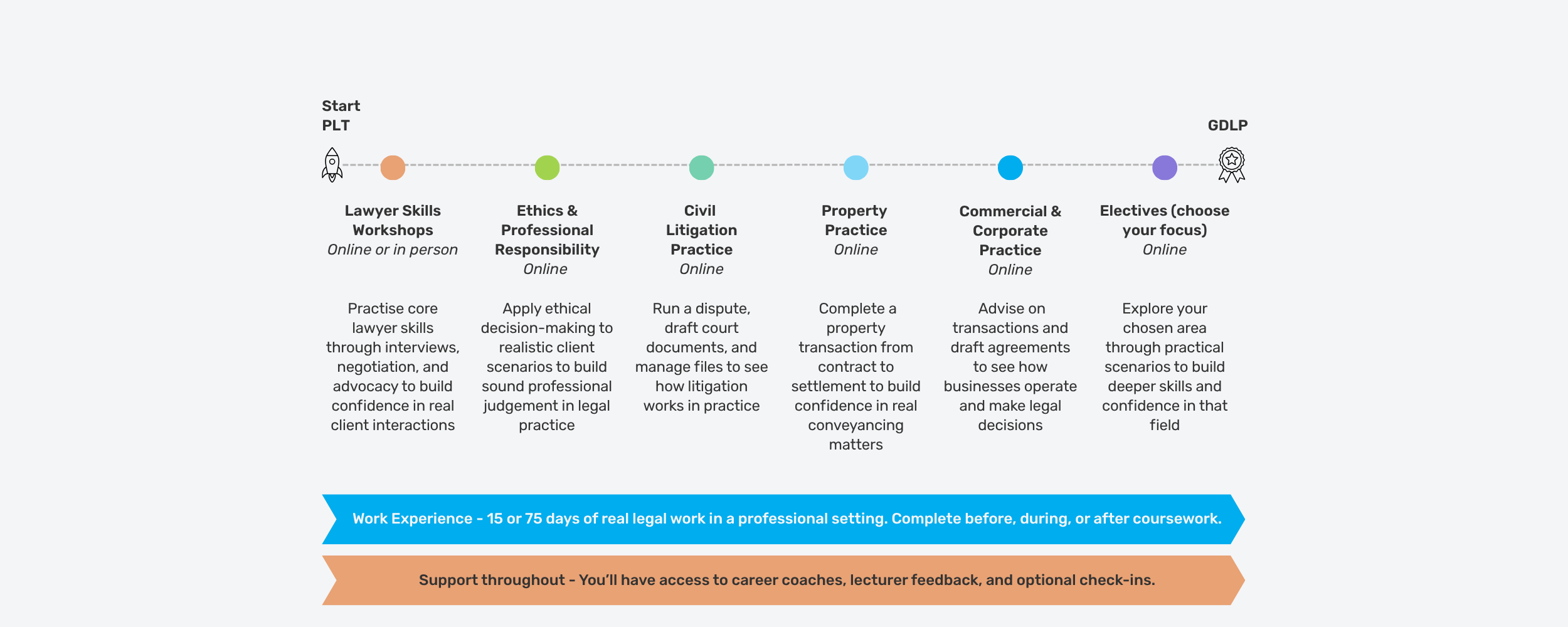
COURSEWORK
This is where PLT starts to feel real. You’ll build practical legal skills through a combination of online learning and interactive workshops.
Most of your coursework is completed online in the Learning Portal, where you’ll work through practical legal tasks such as drafting documents, advising clients, and managing files. You’ll receive ongoing feedback from your facilitator so you can keep improving as you go.
Workshops are built into your coursework and focus on skills that are best developed through real-time interaction, including negotiation, advocacy, client interviews, and courtroom procedure. These sessions are highly interactive and run as role-plays and guided exercises.
You can attend workshops online or in person in Canberra, depending on what suits you. They’re led by practising lawyers, barristers, and judges who bring real-world experience into each session.
How Coursework Works
There are no written exams or academic essays in PLT.
Instead, you’ll develop your skills in a supportive environment before applying them in a real workplace.
- Practical tasks: Work through simulated legal files (typically 2–3 tasks per week full-time, or 1–2 tasks per week part-time), with detailed feedback from your facilitator
- Huddles: Optional 30-minute group check-ins with your facilitator and peers
- Progress quizzes: Short knowledge checks at the end of each subject that you can retake to support your learning
- Practice ready reviews: A 45-minute open-book conversation with a supervising lawyer at the end of each subject, similar to reporting on your work in practice
- Lawyer Skills
- Ethics and Professional Responsibility
- Civil Litigation Practice
- Property Law Practice
- Commercial and Corporate Practice
- Administrative Law Practice
- Banking and Finance Practice
- Consumer Law Practice
- Criminal Law Practice
- Employment and Industrial Law Practice
- Family Law Practice
- Planning and Environmental Law Practice
- Wills and Estates Practice
WORK EXPERIENCE REQUIREMENTS
Options
Option 1:
75 days' work experience
Complete 75 days in a legal workplace.
Option 2:
15 days + 6-week online program
Complete 15 days of work experience plus an additional six weeks of online coursework.
Work experience is where you apply what you’re learning in a real legal workplace and start to see how legal work operates day to day.
As part of Practical Legal Training in the ACT, you’ll complete either 15 or 75 days of work experience, depending on the pathway you choose.
You’ll organise your own placement and can complete your days in one organisation or across multiple workplaces. Your role will need to involve legal work, and many students complete their placement in settings such as law firms, government legal teams, in-house roles, or community legal centres.
You don’t need to have a placement secured before you enrol. Some students complete their work experience during their coursework, while others may complete part or all of it before or after their course. In some cases, prior relevant legal experience may also count towards your requirement.
As a College of Law student, you’ll have access to Career Coaches who can help you get started, prepare applications, and plan your placement.

ACT Entry Requirements
To enrol in practical legal training in the ACT, you need to have:
- Completed your law degree
- Sat your final examination
- Received your results by the enrolment close date (one week before the program starts)
If you meet these requirements, congratulations, you’re ready to apply.
Stale learning clause
The LPAB ACT applies a stale learning provision. If your law degree was completed more than five years before your intended enrolment, your qualifications must be assessed by the LPAB ACT before you can proceed.

Early Commencement
In the ACT, you’ll usually need to complete your law degree before starting Practical Legal Training (PLT).
Unlike some other states, early commencement is generally not permitted. In limited cases, the Legal Practitioners Admission Board ACT (LPAB ACT) may allow you to start early, but only in exceptional circumstances.
If you’re unsure about your eligibility, it’s worth checking before choosing your PLT start date.
CHOOSING YOUR STUDY PACE
You can choose a study pace that fits around your schedule, with full-time and part-time options available. Both lead to the same Graduate Diploma of Legal Practice (GDLP).
You can switch between study modes after you enrol if your circumstances change. Just keep in mind that changes made after the census date may involve a fee.
FULL-TIME
15 weeks
30-35 hrs per week
5 days
Online or on campus
Students with full-time availability
PART-TIME
30 weeks
15–17 hours per week
5 days or 12 evenings
Online or on campus
Working professionals or those with other commitments
FEES & PAYMENT
Program Fees
Practical Legal Training
Domestic $9,200
International $13,270
15-day work experience & 6-week online program (optional)
Domestic $1,690
International $1,690
75-day work experience
Included for both domestic and international students
What’s included
Your PLT fee covers everything you need to complete the course. This includes:
- All course materials and Learning Portal access
- One-on-one career coaching: available during your PLT and for one year after you finish
- A matched legal practitioner mentor
- Access to College Connect, our online student community
- Ongoing support from facilitators and student services
Payment options
- FEE-HELP (eligible domestic)
- Upfront payment
- Scholarships and bursaries
FREQUENTLY ASKED QUESTIONS
In the ACT, you’ll usually need to complete your law degree before starting PLT.
Unlike some other states, early commencement is generally not permitted. In limited cases, the Legal Practitioners Admission Board ACT (LPAB ACT) may allow you to start early, but only in exceptional circumstances.
If you’re unsure, it’s worth checking before choosing your start date.
You’ll only attend 5 days of workshops, with more than 80% of your PLT completed online.
Some courses are fully online, while others include 5 days on campus in Canberra — you can choose what works best for you.
In the ACT, you’ll usually need to have your final results before starting PLT.
If your results won’t be released in time, you’ll need permission from the LPAB ACT to start early. It’s best to contact them as soon as possible.
Both options meet the LPAB ACT requirements, so it really comes down to what works best for you.
The 75-day option is a good fit if you already have, or are planning to gain, more hands-on legal work experience.
The 15-day option combines a shorter placement with a six-week online program, and can suit students balancing PLT with work, study, or other commitments.
Yes, as long as you’re completing legal work under the supervision of an Australian legal practitioner.
Many ACT students complete their placement in Commonwealth legal teams, the Attorney-General’s Department, the APS, and national regulators.
Yes. Eligible domestic students can use FEE-HELP to cover the PLT course fee and, if you choose it, the 15-day work experience option.
Yes. Once you’re admitted in the ACT, you can apply for admission in other states and territories under Australia’s mutual recognition framework.
A practice ready review isn’t a written exam — it’s a conversation.
You’ll speak with a supervising lawyer about your work, similar to how you’d report to a senior in practice. It’s open-book, structured, and focused on helping you build confidence.
Yes, you can switch between study modes if your circumstances change.
Just keep in mind that changes made after the census date may involve a fee.

ABOUT THE COLLEGE OF LAW ACT
For more than 50 years, the College of Law has been preparing law graduates to enter the profession with confidence. Since 1974, over 100,000 graduates have completed their training with the College across Australia.
In the ACT, the College has been delivering Practical Legal Training since 2004, working closely with the local legal profession to support graduates as they move from university into practice. The program is approved by the Legal Practitioners Admission Board ACT (LPAB ACT), which oversees PLT providers in the territory.
As a not-for-profit provider, the College partners with practising lawyers, government legal teams, and employers to ensure its PLT reflects how legal work is carried out today.
The College offers PLT programs nationwide, with campuses in Sydney, Melbourne, Brisbane, Adelaide, and Perth, and courses recognised by the relevant admitting authorities in each state and territory.