
START HERE
If you’ve Googled “Practical Legal Training”, you’re probably asking one of these:
How does PLT actually work?
How long does it take?
When can I start?
What does it involve?
This page is your starting point.
We’ll keep it simple.
Then, if you want the full picture, you can download the guide.
WHAT TO EXPECT FROM PLT
If you’re new to PLT, here’s a simple overview of how it works.
Practical Legal Training is the compulsory program you complete before applying for admission as a lawyer in Australia.
It’s different from university.
Less theory.
More doing.
Instead of essays and written exams, you complete tasks that reflect the kinds of matters lawyers handle every day, such as drafting documents, advising clients, managing files and applying professional judgement.
PLT bridges the gap between law school and legal practice. It is designed to help you move from understanding the law to applying it in real-world situations.
PLT is made up of three core parts:
Coursework
Practical subjects delivered through workshops and guided online learning. You’ll complete realistic tasks and receive feedback from experienced practitioners.
Work experience
A placement in a legal environment where you apply what you’ve learned and begin working under supervision in a professional setting.
Professional skills development
Short modules focused on communication, commercial awareness and workplace capability, which are the skills employers expect of entry-level lawyers.
Together, these elements provide a structured and supported pathway into legal practice.
Coursework typically takes 15 to 30 weeks, depending on your study mode and state.
Many students balance PLT with part-time or full-time work.
There are clear milestones to guide your progress. There are no traditional lectures and no written exams. The focus is on developing practical competence and confidence.
Most students begin PLT after completing their law degree and receiving their final results.
In some circumstances, you may be eligible to start earlier if you have completed your Priestley 11 core subjects, with no more than two electives remaining (subject to approval from the admitting authority in your state).
You don’t need to have your work experience lined up before starting PLT.
If you’d like the full detail, including study formats and state-specific options, the Practical Legal Training Guide explains it step by step.
WHAT SETS THIS PROGRAM APART
Students choose the College because:
Train like a lawyer
Complete tasks that reflect real legal work, without essays or written exams, so you can focus on building practical skills.
Learn from practitioners who’ve been in your shoes
Your lecturers bring real-world legal experience and practical feedback. Mentors and career coaches support you as you prepare to enter the profession.
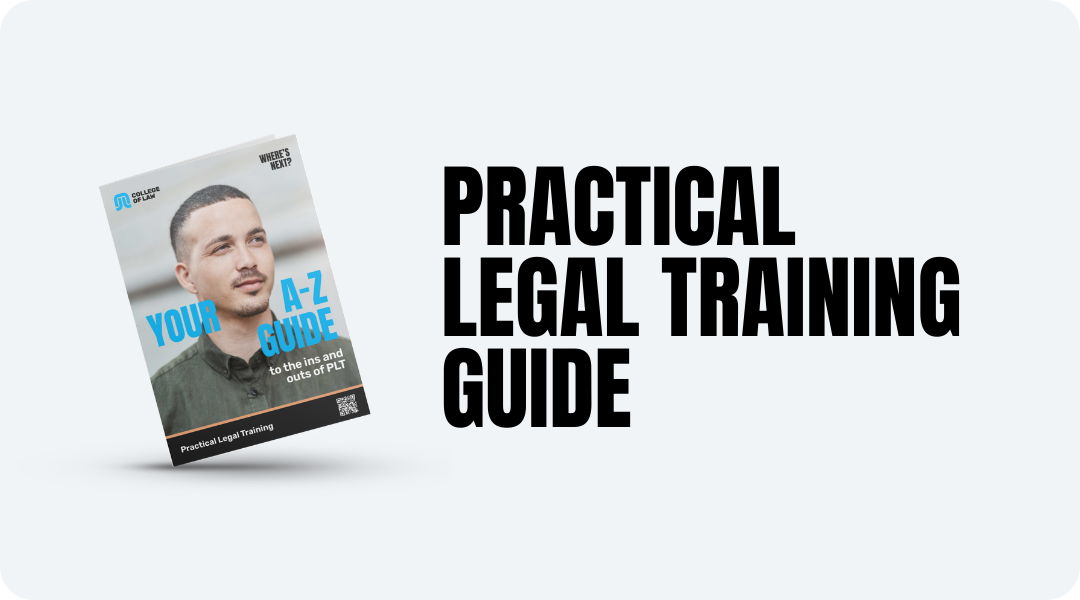
This page gives you the overview.
The Practical Legal Training Guide gives you the detail.
If you’re comparing providers or planning your admission timeline, the guide brings everything together in one place.
Inside, you’ll find:
• A complete breakdown of how PLT works
• Study options explained clearly
• Work experience pathways compared side by side
• State-specific formats (including NSW)
• Fees, FEE-HELP and scholarship information
• Admission timing guidance
It’s designed to help you compare your options and plan your next 6–12 months with confidence.
You don’t need to have secured work experience before applying. This guide explains how placements work and what to expect.
WHAT STUDENTS SAY

AUSTRALIA'S LARGEST PROVIDER OF PLT

READY TO LOOK MORE CLOSELY
PLT is the final stage before admission.
If you’re planning your next step, the guide explains your options in more detail, so you can move forward knowing what to expect.
Download it, read it at your own pace and decide what works for you.
FREQUENTLY ASKED QUESTIONS
Now that you’ve completed (or nearly completed) your law degree, you have a strong theoretical understanding of the law.
But you’re not ready to enter the workforce. Not yet.
PLT equips you with the practical, day-to-day skills you need as an entry-level lawyer. You know, the court-appearing, contract-preparing, law-talking kind.
Think of your PLT as the perfect finishing school. A space to practice your skills and build your confidence as an entry-level lawyer who’s ready to soar.
After completing your PLT, you will be awarded a Graduate Diploma of Legal Practice (GDLP). This means you’ll be eligible to apply for admission as a legal practitioner in your state or territory.
You can start your PLT if you have completed all Priestley 11 core subjects of your law degree – with no more than two electives remaining.
To start your PLT before completing your law degree, you’ll need to seek approval from the admitting authority in your state. Find out more here.
In the Australian Capital Territory, except in rare circumstances, you cannot start your PLT until you’ve completed your degree.
Our full-time course is 15 weeks.
Our part-time course is 30 weeks. (This is a good option if you work full time or have other commitments.)
During your studies, you'll gain an understanding of the theory of law and study key areas known as the 'Priestley 11’:
- Administrative law
- Civil Procedure
- Company Law
- Constitutional Law
- Contracts
- Criminal Law and
- Procedures
- Equity (including Trusts)
- Evidence
- Professional Conduct (including Basic Trust Accounting)
- Property, both Real (including Torrens System Land) and Personal
- Torts
Keep in mind, there may be additional subjects and electives you'll need to complete, based on your university's requirements.
While it's possible, we generally don't recommend it. Full-time study is 30-35 hours per week for 15 weeks with 2-3 tasks due each week.
PLT is your chance to practice skills before entering the workforce, and having enough time for it ensures the best start to your legal career.
The full-time course is fast-paced, and catching up if you fall behind can be challenging.
On the other hand, the part-time course offers a more relaxed pace. It covers the same content over 30 weeks and is perfect for those with work or family commitments.
Keep in mind, you can switch to part-time in the first week if needed.
You can transfer between PLT programs. If you transfer or defer after the census date, a fee will apply.
When enrolling, be realistic about the time you can commit to studying and select a program that offers the pace that best fits your lifestyle.
Part-time: A flexible option that allows you to set your own schedule, committing your 15-17 hours per week to the times that work best for you.
Full-time: For those who are able to commit to full-time study. Full-time immersive courses are 30-35 hours per week.
Yes, you can complete your PLT in any state, no matter where you obtained your law degree.
It's a good idea to consider doing your PLT in the state where you want to practise as a lawyer though, as the coursework is designed to match that specific jurisdiction’s requirements. However, you still have the option to be admitted as a lawyer in any state, except for South Australia and Tasmania, as they have unique requirements.
For South Australia and Tasmania, there are special rules in place. Please reach out to our Customer Engagement Team for more details.
Once you've become a lawyer, you can also seek admission in other Australian states or territories either through the Mutual Recognition Scheme or by applying directly.
Overseas students with an Australian law degree can undertake any of the PLT programs. Our online PLT programs don’t require any on campus attendance. You will only need to participate in live online workshops held between 9am to 5pm, in the local Australian time zone.
You can also complete any of our blended PLT programs. You will need to make sure that your travel documents allow you to study in Australia to attend the five days of onsite workshops.
Once you’ve finished your Practical Legal Training, you’re almost a lawyer—but not quite yet! The next step is applying to the admitting authority to become officially admitted.
To be admitted, you’ll need to:
- Complete a law degree or equivalent.
- Finish your Practical Legal Training.
- Be recognised as a "fit and proper person" by the admitting authority.
In simpler terms, being a "fit and proper person" means they want to make sure you have a good moral character to interpret, argue, and draft the law.
To prove it, you'll have to let them know if you have any criminal, academic or general misconduct history. Make sure you check the specific rules in your state's admissions authority before moving forward.
When you finally get the green light, get ready to attend an admission ceremony where you'll officially become a lawyer. It’s a chance to celebrate with your friends, family, and colleagues – it's a big achievement!
Practical Legal Training and the Graduate Diploma of Legal Practice are essentially the same thing.
When you finish your PLT, you get a Graduate Diploma of Legal Practice qualification. Both are about the training you need after your law degree to become a practising lawyer.
Sometimes people call it by the course name (Practical Legal Training), and other times the qualification you receive (Graduate Diploma of Legal Practice).
So, whether you hear PLT or GDLP, you're on the right track for your legal journey.
There are no lectures, classes, tutorials, or anything like that.
The best way to learn how to be a lawyer, is completing tasks just like the ones you’ll be tackling on the job, and that's what you will spend your time doing.
No, there are no other required attendance dates besides the workshops.
You will complete an online practice ready review at the end of each subject. The review lasts up to 40 minutes, and you can choose a time from a list of available appointments.
Practical Legal Training is not like university, it’s 100% hands-on. The workshops are interactive and require your participation, so they are mandatory.
If you cannot attend a workshop session, you can submit a special consideration request to support@collaw.edu.au.
In some circumstances, it may be possible to attend the workshop later. We cannot guarantee that your special consideration will be approved, and we may recommend that you enrol in a later intake.
There are no traditional written exams here. Our Practical Legal Training (PLT) is all about being hands-on and practical.
After workshops, you'll jump into our interactive Learning Portal where you’ll tackle tasks that feel like real-world scenarios.
To make sure you feel ready to take on the challenges of a legal workplace, you’ll complete a “practice ready review” for each subject. But they’re not your typical test.
Picture a conversation with an evaluator (who is a lawyer), stepping into the shoes of your supervisor. You’ll review the tasks you've completed for a subject and discuss how and why you’ve settled on your conclusions – just like how real matters operate with your supervisor at work.
The practice ready review is all about boosting your confidence, ensuring you're ready to take on the challenges of a legal workplace.
You can start your work experience up to 2 years before beginning your PLT.
You will need to complete at least 15 days work experience in Australia after starting the PLT program and accrued at a minimum rate of 2 days per week.
You can undertake the remainder of your work experience before, during or after you begin the PLT program.
You can accrue up to 60 days work experience in the two years prior to starting your Practical Legal Training.
To be eligible, your work experience must comply with the Work Experience Rules. In short, your work experience:
- Must occur in the delivery of legal services
- Must be under the supervision of an appropriate supervisor
- May be undertaken in one or multiple placements
- May include experience undertaken as an undergraduate (but such experience cannot be used to satisfy the entire placement).
To count towards your PLT, your work experience must:
- Occur in the delivery of legal services
- Be under the supervision of an appropriate supervisor
- Comply with the work experience rules
You can find out if your work experience can count towards your PLT by submitting an Application for Approval Form to support@collaw.edu.au
This form can be submitted before you enrol at the College of Law, and we’ll keep a record of your work experience.
Work experience undertaken before you begin your PLT program can count towards some, but not all, of your PLT work experience.
All students need to complete 15 days’ work experience after beginning their PLT program.
If you’re completing the 75-days work experience option, the remaining 60 days work experience can be undertaken in the 2 years prior to starting your PLT program.
A person can be your work experience supervisor if they are an Australian legal practitioner and are currently practising and:
- hold a full practising certificate as a legal practitioner;
- hold a restricted practising certificate as a legal practitioner which they have held for 2 years;
- are a judge;
- are a tribunal member who is a legal practitioner; or
- are a person who does not hold a practising certificate but is eligible to do so and who provides acceptable written submission to satisfy the Committee they can provide appropriate practical experience.
Information about the role of supervisors can be found in the Work Experience Guide for Supervisors
Getting your work experience approved is a straightforward process that involves six simple steps.
You don't even need to be a College student to have your work experience recorded for future use in your PLT journey.
Here are the five steps to follow:
- Carefully read through the Work Experience Rules
- Share the Work Experience Guide for Supervisors with your supervisor so they understand the requirements
- Email your completed Work Experience Approval Form before or shortly after you begin your placement
- We'll review your application and inform you of the outcome
- Once you finish your placement, email the Work Experience Declaration Form (or NSW Declaration Form, if you're studying in NSW), signed by your supervisor, to the College
You can find all the forms you need below:
Guide for Students
Guide for Supervisors
Work Experience Rules
Application for Approval Form
Declaration Form
Declaration Form (NSW)
Remote Supervision Diary
Journal
Clinical Experience Module Enrolment Form
Just click the links to access what you need!
The College of Law does not guarantee work experience placements for students.
If you enrol in the College’s PLT program, you will have access to one-on-one career consultations with a Careers Advisor for guidance on finding work and planning your career.
You can also visit the College of Law's Jobs Board to view and apply for opportunities for law graduates.
Yes. If you are completing work experience remotely, you will need to complete the Work Experience Remote Supervision Diary.
Your work experience must still comply with the Work Experience Rules.
College students on unpaid approved work experience placements are insured for personal injury and civil liability.
You can request a copy of our Certificates from support@collaw.edu.au
Nope, you don't need your exam results to enrol. Here's when you'll need to provide them:
In the ACT, VIC and WA, you have until the enrolment close date (one week before the course begins).
In NSW, NT and SA, you'll need to provide them by the program census date.
In Queensland, you have until the end of the program to provide your exam results.
You can enrol in the course up until the Monday before it starts, which is one week before the course begins.
After you submit, you'll get an email acknowledgment. If we need more information, we'll contact you.
Expect your enrolment confirmation in 5-10 business days.
International students studying outside of Australia are not required to have a USI.
To complete the enrolment form, simply:
- Enter an overseas address
- Select ‘Studying Outside of Australia’ in the ‘Citizenship’ section
- Leave the USI field blank
You can pay by:
- Credit card (Visa, MasterCard, or Amex)
- Direct deposit into The College of Law's account
Keep in mind, non-FEE-HELP students must pay the full fee when enrolling. If you use FEE-HELP, no upfront payment is needed, and you can split payments between FEE-HELP, self-funding, or employer contributions
Yes. FEE-HELP (a student loan provided by the Federal Government) is available for eligible students. You can use FEE-HELP to pay all or part of your tuition fees.
To become a lawyer in Australia with an overseas law degree, you'll need to have your qualifications evaluated by the admitting authority in the specific state or territory where you want to practice.
Depending on their assessment, you may have to complete the entire PLT program or just specific subjects within it. We provide individual PLT subjects for students who are required by the admitting authorities to take certain PLT subjects while being exempt from others.
Yes, we offer single PLT subjects for overseas solicitors and others who are required by an admitting authority to complete some subjects of the PLT program.
You will need to have your law qualifications assessed by the admitting authority in the state or territory you wish to practice in before enrolling in the subjects.
Yes, if your law degree is from a country where English isn’t the main language, you’ll need to prove your English proficiency.
The required IELTS standard is at level 8 (writing), 7.5 (speaking), 7.0 (reading) 7.0 (listening) and 7.5 overall.
You’ll need to submit a certificate showing you’ve met these standards.
If you’ve finished an Australian law degree and you’re an international student, we’re here to help. We can assist you in applying for an 11-month visa to complete your PLT.
You’ll need to enrol in our CRICOS-approved, Weekly On-Campus PLT program held at our Sydney CBD campus (CRICOS course code 069734C). We’ll also provide you with an electronic Confirmation of Enrolment (eCOE) to get your student visa.
Absolutely! In some states, you can choose to do your Practical Legal Training completely online, including in the states and territories where it is available.
Just remember, our online courses include 5 days of on-campus attendance in Australia. Make sure your travel documents are ready so you can join us for these onsite sessions.
- ACT: Legal Practitioners Admission Board
- NSW: Legal Profession Admission Board
- NT: Legal Practitioners Admission Board
- QLD: Queensland Legal Practitioners Admissions Board
- SA: Legal Practitioners Education and Admission Council
- TAS: Board of Legal Education
- VIC: Victorian Legal Admissions Board
- WA: Legal Practice Board
Sydney is a major international city and the College campus is located in the centre of the CBD. The cost of living is high by Australian standards but lower than other major international cities such as London, New York or Tokyo.
There are many accommodation options but, once again, the price of accommodation tends to be high by Australian standards. Some examples of accommodation suitable for students can be found here.
There are a great many options for recreational and social activities in Sydney and surrounding regions. Sydney is famous for its sporting stadiums, theatrical and cultural activities, bars and restaurants, bush and beaches, and features the most beautiful harbour in the world.
Studying in a foreign city is exciting but comes with special challenges, especially if you do not have friends or family already here.
Any questions regarding your enrolment or learning at the College should be directed to your lecturer. For other issues, the College has a Student Liaison Officer able to help with basic questions. Possible issues may include:
- English language problems: you are required to have good English skills to enrol in the course but if you are struggling to understand the College may be able to help by delaying your Coursework while you take a refresher course in English.
- Legal problems: the College is not able to provide legal advice but may be able to assist with finding you an appropriate legal service.
- Employment rights: you are entitled to work in paid employment for up to 20 hours per week across the duration of your student visa. You are also entitled to work an additional 35 hours per week (for a maximum of 15 weeks) in satisfaction of your Work Experience Component.
The College is not able to advise you if you are having problems in the workplace but will help you to find an appropriate legal service should that be required.
You can also contact the Commonwealth Ombudsman if you wish to make a complaint regarding your experience at the College.
If you need to extend or obtain your student visa through the College of Law, you are required to complete our Weekly On-Campus program at our Sydney CBD campus (CRICOS course code 069734C).
During the program, you will attend campus on Monday to Friday 9 to 5pm for the first week and Monday to Wednesday 9.00am to 3.30pm for the remainder of the 15-week program.
When you apply for the Weekly On-campus program, we can provide you with an eCOE, which will allow you to apply for an 11-month student visa.
To keep your student visa, you’ll need to follow some rules, including attendance, progress, transfers, and assessments. It’s important to attend all your classes and meet the College’s academic standards. If these requirements aren’t met, your visa could be shortened or even cancelled.