
PRACTICAL LEGAL TRAINING NEW SOUTH WALES
If you’re finishing your law degree in New South Wales and planning to become a lawyer, Practical Legal Training (PLT) is your next step.
The College of Law’s PLT program is approved by the Legal Profession Admission Board (LPAB) and is chosen by more PLT students than any other provider in Australia. It’s designed to help you build the practical, job-ready skills used in legal practice, with no written exams or academic essays.
From 1 March 2026, the LPAB introduced updated requirements for PLT in NSW. This means your course now includes 15 days of on-campus training and 15 days of work experience, alongside flexible coursework designed to fit around your schedule.
When you complete PLT, you’ll graduate with a Graduate Diploma of Legal Practice (GDLP), the qualification required to apply for admission in New South Wales.

Key facts about Practical Legal Training in New South Wales:
In New South Wales, Practical Legal Training (PLT) is the next step after your law degree, preparing graduates for admission to the legal profession by building practical, job-ready skills through structured coursework and required work experience, with a combination of online learning and 15 days of on-campus training in Sydney.
- Complete your PLT in 15 weeks
- Attend 15 days of on-campus workshops in Sydney CBD
- Study through a mix of online coursework and in-person training
- Complete 15 days of work experience in a legal workplace
- Learn through practical legal tasks that reflect real legal work
- Graduate with a Graduate Diploma of Legal Practice (GDLP), approved by the LPAB
WHAT IS PRACTICAL LEGAL TRAINING IN NEW SOUTH WALES?
Practical Legal Training (PLT) is where your legal training shifts from theory into practice. It sits between your law degree and admission as a solicitor in New South Wales, helping you develop the practical skills needed to work in a real legal environment.
Once you complete PLT, you’ll receive a Graduate Diploma of Legal Practice (GDLP), which allows you to apply for admission in New South Wales.

COURSEWORK
Your PLT coursework in New South Wales is designed to help you build practical legal skills through a combination of online learning and in-person workshops.
It's made up of online coursework completed over 15 weeks, with 15 days of workshops scheduled at different points throughout the course.
Most of your study takes place in the Learning Portal, where you’ll work through practical legal tasks such as drafting documents, advising clients, and managing files. You’ll receive ongoing feedback from your facilitator as you progress through each subject.
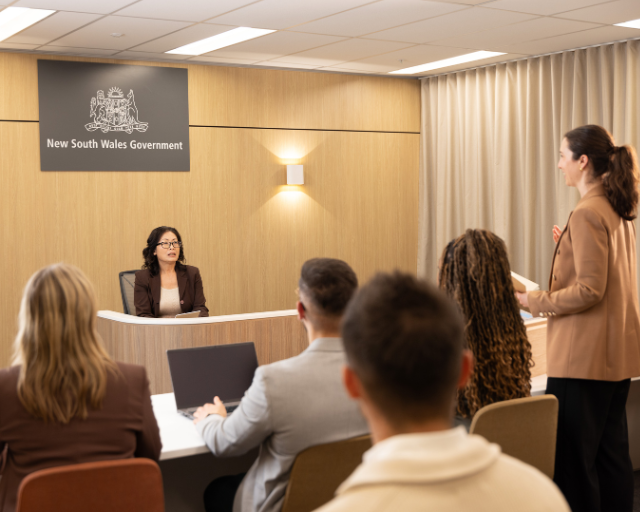
Workshops are a scheduled part of your coursework and make up 15 days of the course. They focus on skills that are best developed through real-time interaction, including negotiation, advocacy, client interviews, and courtroom procedure. These sessions are highly interactive and run as role-plays and guided exercises.
How Coursework Works:
There are no written exams or academic essays in PLT.
Instead, you’ll build your skills step by step in a supportive environment before applying them in a real workplace.
- Virtual practice tasks: Work through simulated legal files (typically 1–2 tasks per week part-time), with feedback from your facilitator
- Huddles: Optional 30-minute group check-ins with your facilitator and peers
- Progress quizzes: short knowledge checks at the end of each subject that you can retake to support your learning
- Practice ready review: A 45-minute open-book conversation with a supervising lawyer at the end of each subject, similar to reporting on your work in practice
- Lawyer Skills
- Ethics and Professional Responsibility
- Civil Litigation Practice
- Property Law Practice
- Commercial and Corporate Practice
- Administrative Law Practice
- Criminal Law Practice
- Family Law Practice
- Consumer Law Practice
- Employment and Industrial Law Practice
- Planning and Environmental Law Practice
- Wills and Estates Practice
- Banking and Finance Practice
WORK EXPERIENCE
PLT Work Experience Requirements in NSW
Amount
15 days required.
No extra coursework
15 days fully satisfy the admission requirements...No additional coursework needed.
Support from Career Advisors
Guidance is available if you need help finding or applying for opportunities..
Work experience is where you apply what you’re learning in a legal workplace and start to see how legal work operates day to day.
You’ll organise your own placement and can complete your days in one organisation or across multiple workplaces, depending on what suits you.
You don’t need to have a placement secured before you enrol. Many students complete their work experience during their coursework, while others may complete it after their course.
Getting it approved
Before you start, make sure your placement is approved so it counts:
- Read the Work Experience Rules.
- Give your supervisor the Work Experience Guide for Supervisors.
- Submit your Work Experience Approval Form before (or soon after) you begin.
When finished, submit your Declaration Form and Journal signed by your supervisor.
You’ll need to follow this approval process for each separate work experience placement.
Find legal roles on our Jobs Board
Explore a wide range of legal roles and start gaining experience alongside your PLT.
Opportunities include part-time, graduate, and entry-level opportunities across firms, government, and in-house teams.
HOW LONG DOES PLT TAKE?
In New South Wales, the coursework component of Practical Legal Training (PLT) typically takes 15 weeks.
You’ll also complete 15 days of work experience in a legal workplace as part of your PLT.
The total time it takes to finish will depend on how you choose to complete your work experience. Many students complete their placement during their coursework, while others may complete it before or after their course.
Once you’ve completed your coursework, work experience, and any remaining course requirements, you’ll be awarded a Graduate Diploma of Legal Practice (GDLP), which allows you to apply for admission in New South Wales.

What are the entry requirements for PLT in New South Wales?
Many students begin PLT shortly after finishing their law degree (or double degree), although it’s also possible to start earlier with approval from the Legal Profession Admission Board (LPAB).
The College of Law’s PLT program in New South Wales is approved by the LPAB, the body responsible for setting admission requirements in NSW.
To enrol in PLT in New South Wales, you’ll need to have:
- Completed all Priestley 11 core subjects
- Have sat your final exam for your law degree (or double degree)
- Received your results by the program census date
If you meet these requirements, you’re ready to apply.
Stale learning clause: If you completed your law degree (or double degree) more than 5 years ago, you will need to have your qualifications assessed by the Legal Profession Admission Board before enrolling.

Can You Start PLT Early in New South Wales?
In some cases, you may be able to start PLT before completing your law degree (or double degree).
To do this, you'll need approval from the Legal Profession Admission Board (LPAB). You may be eligible if you:
- Have completed all Priestley 11 core subjects
- Have no more than two elective subjects remaining
- Are currently enrolled in those remaining subjects
How to apply for early commencement:
- Submit an Application for Early Commencement of PLT to the LPAB
- Provide a letter from your Law School confirming your completion of Priestley 11 subjects and current enrolment
- Submit payment for the application
You’ll need to provide proof of LPAB approval to the College by the census date.
COURSE OPTIONS IN NEW SOUTH WALES
From 1 March 2026, all NSW PLT courses include 15 days of on-campus workshops and 15 days of work experience.
|
PLT |
PLT 2 WEEKS & 5 DAYS ON-CAMPUS |
PLT 1 WEEKS & 10 DAYS ON-CAMPUS |
PLT WEEKLY ON-CAMPUS (CRICOS APPROVED) |
PLT ATTENDANCE EXEMPTION | |
|---|---|---|---|---|---|
| Duration | 15 weeks | 15 weeks | 15 weeks | 15 weeks | 30 weeks |
| Pace | 15-20 hrs study per week | 15-20 hrs study per week | 15-20 hrs study per week | 15-20 hrs study per week | 15-20 hrs study per week |
| Workshops | 3 weeks on-campus | 2 weeks and 5 days on-campus (Mon, Wed or Fri) | 1 week & 10 days on-campus (Mon, Wed or Fri) | 5 days week one on-campus & 3 days every following week | 5 days online |
| Workshop Location | Sydney CBD | Sydney CBD | Sydney CBD | Sydney CBD | Online |
| Online coursework | Online throughout the course (majority of study) | Online throughout the course (majority of study) | Online throughout the course (majority of study) | Online throughout the course (majority of study) | Online throughout the course (majority of study) |
FEES & PAYMENT
PLT Program Fees
Domestic:
$9,200
International:
$13,270
What's included
Your PLT fee covers everything you need to complete the course. This includes:
- All learning materials and resources
- Book one-on-one career consultations with our Career Coaches during your PLT and for one year after you finish
- Access to a legal practitioner mentor
- Access to College Connect, our online student community
- Ongoing support from facilitators and student services
Payment Options
- FEE-HELP (eligible students)
- Upfront payment
- Scholarships and bursaries
MEET YOUR PLT LECTURERS IN NEW SOUTH WALES
Your PLT is taught by experienced New South Wales legal practitioners who understand how law is practised in the state.
They’ll guide you through practical skills and real-world scenarios based on NSW laws, procedures, and professional practice, helping you build the confidence to step into legal work in New South Wales.

Michael Appleby
Senior Lecturer
BA, LLB
Michael has over 50 years' legal experience and has taught PLT skills at the College for 20 years.

Sharyn Croke
Lecturer
DipLaw, MHist, GradCertArts, PGCertLaw, LLM
With 25+ years in law, Sharyn mentors future lawyers, sharing insights on ethics and justice.

Tania Digges
PLT NSW Assistant Director - Head of Campus Course
Bec, LLB (Hons)
Tania Digges is a senior lecturer who has taught in both the Masters of Applied Law program and across all of College’s PLT offerings. She is a specialist in construction law with experience in engineering and infrastructure projects in Australia, the UK, Europe, South East Asia, the Middle East and South America.

Andrew Johnson
Lecturer
BEng, BA, BLLP(Hons)
Since 2009, Principal at Johnson and Associates Lawyers. Previous roles include solicitor at Groom & Lavers, McCullough Robertson, Herbert Geer, in-house lawyer for Queensland Rail, and lecturer at Griffith University and College of Law (NSW).

Michael Joyce
Assistant Director
LLB(Hons)
I have been a solicitor since 1989 mainly in general practice. I have taught at The College of Law since 2003 and am Head of the Online Courses in NSW since 2020.

Asheesh Kalmath
Lecturer
BA, LLB
Asheesh Kalmath is a Sydney-based lawyer and lecturer at the College and University of Sydney.

Jason Keane
Lecturer
BA(Hons), LLB, LLM
Jason Keane has over 30 years in legal practice and is a member of the Law Society of NSW.

Paul Mead
Assistant Director
DipLaw, GradCertHighEd
Paul has, in over forty years in legal practice, engaged in private practice in Sydney and Country NSW, the Law Society of England and Wales (Legal Aid) and Westminster City Council City Solicitors Office, as well as in corporate practice in NSW and the ACT.

Diana Mills
Adjunct Lecturer
BA, LLB, GradDipMentalHealth
Diana, admitted in AU, HK & UK, has lectured at the College since 2015 and teaches MHFA.

Marco Piazza
Assistant Director
BEc, LLB, LLM
Marco Piazza was a solicitor, lecturer, and mediator before joining the College in 2004.

Rina Sheftalovich
Lecturer
BBus, LLB, LLM
Rina is a senior commercial litigator, with experience in a wide range of commercial disputes predominantly in medium-sized legal practices in Sydney. She is currently a co-chair of the NSW Civil Litigation Practice Group.

Tiffany Thomas-McCarthy
Assistant Director
BBus, LLB, GDLP
Prior to commencing work at the College of Law in 2011, Tiffany worked in medium sized firms and a small boutique firm specialising in instance litigation, product liability and property claims, and estate litigation.

Florence Thum
Assistant Director and Lecturer, Psychotherapist and Coach
LLB, GradCertEd, Mcounselling and Applied Psychotherapy, LLM
Former litigation and dispute resolution lawyer with postgraduate qualifications in law, education and psychotherapy, Florence is keen to extend your professional skills in the modern workplace.

Kye Tran-Tsai
Lecturer
LLB, LLM (Hons), Acc. Spec. (Prop)
Kye is an Accredited Specialist in Property Law (NSW) with experience leading practice teams.

Timothy Walter
Lecturer
BA, LLB
Tim Walter has worked for the NSW Port Authority, for law firms in London, and for medium and large city law firms in Sydney and Canberra, as well as in general practice with suburban law firms, eventually becoming an Accredited Specialist in Personal Injury Law, before joining the College of Law as a lecturer.
FREQUENTLY ASKED QUESTIONS
Yes. The College of Law’s Practical Legal Training program is approved by the Legal Profession Admission Board (LPAB). When you complete the program, you’ll be awarded a Graduate Diploma of Legal Practice (GDLP), which meets the PLT requirement for admission in New South Wales.
From 1 March 2026, the LPAB introduced updated requirements for how PLT is delivered in NSW. All courses now include 15 days of on-campus workshops (previously 5 days) and 15 days of work experience (previously 75 days).
These changes apply to all PLT providers in New South Wales. The overall content and outcome of PLT hasn’t changed — you’ll still build the same practical legal skills needed for admission.
Yes, in some cases. If you’ve completed all Priestley 11 core subjects and have no more than two elective subjects remaining, you can apply to start PLT early.
You’ll need to apply to the LPAB and provide supporting documentation as part of the early commencement process.
Yes. In New South Wales, you’ll need to provide your final exam results by the program census date.
If you’re starting PLT early, you’ll also need to provide proof of LPAB approval by the census date.
Yes. The LPAB will require all NSW students to attend 15 days' on-campus learning for all PLT courses in NSW. These sessions focus around hands-on, practical skill development that complements your online coursework.
At the College of Law, you’ll have flexibility in how you complete those 15 days, with several course formats to choose from:
- 3 Weeks On-Campus: Three consecutive weeks.
- 2 Weeks & 5 Days On-Campus: Two consecutive weeks, then one day a week for five weeks.
- 1 Week & 10 Days On-Campus: One week, then one day a week for ten weeks.
- Weekly On-Campus: Three days each week throughout your course.
Each format delivers the same learning outcomes, just designed to fit around your life.
No. There are no written exams or academic essays in PLT.
Instead, you’ll build your skills through practical tasks, short progress quizzes (which you can retake), and practice ready reviews, structured conversations with a supervising lawyer that reflect how work is reviewed in practice.
If your course begins on or after 1 March 2026, the new Work Experience Rules apply.
All 15 days of work experience must be completed after you start your PLT – previous experience can’t be credited toward the requirement.
Yes. Remote work experience is allowed, as long as you meet the supervision requirements and complete the Remote Supervision Diary
Yes. FEE-HELP is available for eligible domestic students for the PLT coursework component.
Work experience is included in the course fee, with no additional cost.
If you’ve completed your law degree overseas, you’ll first need to have your qualifications assessed by the LPAB.
Depending on the outcome, you may need to complete additional academic subjects before starting PLT.
Yes! To make attendance easier for students across NSW, we’ll be offering on-campus PLT courses outside Sydney CBD in:
- Parramatta
- Armidale
- Wollongong
- Coffs Harbour
- Lismore
Each regional course offers the same high-quality, hands-on learning experience as our Sydney courses, just closer to home.
In New South Wales, admission is granted by the Supreme Court of New South Wales, following a recommendation from the LPAB.
Once you’ve completed your law degree, your PLT (GDLP), and meet the “fit and proper person” requirements, you can apply to the LPAB and then to the Supreme Court for admission.
ABOUT THE COLLEGE OF LAW NEW SOUTH WALES
The College of Law was established in New South Wales in 1974 and has been part of the legal profession for more than 50 years. Since then, the College has supported over 100,000 graduates across Australia as they take the next step into legal practice.
In New South Wales, the College has a long-standing connection to the profession, working closely with law graduates as they transition from university into practice. Today, it is the most chosen PLT provider in the state.
The College’s Sydney campus at 570 George Street places students in the centre of the CBD, close to courts, law firms, and the legal community they are preparing to join.
As a not-for-profit provider, the College works in partnership with practising lawyers and employers to ensure its Practical Legal Training reflects the realities of modern legal practice.
The College delivers PLT programs across Australia, with campuses in Adelaide, Brisbane, Melbourne, and Perth, and courses accredited by the relevant legal admissions authorities in each state.